

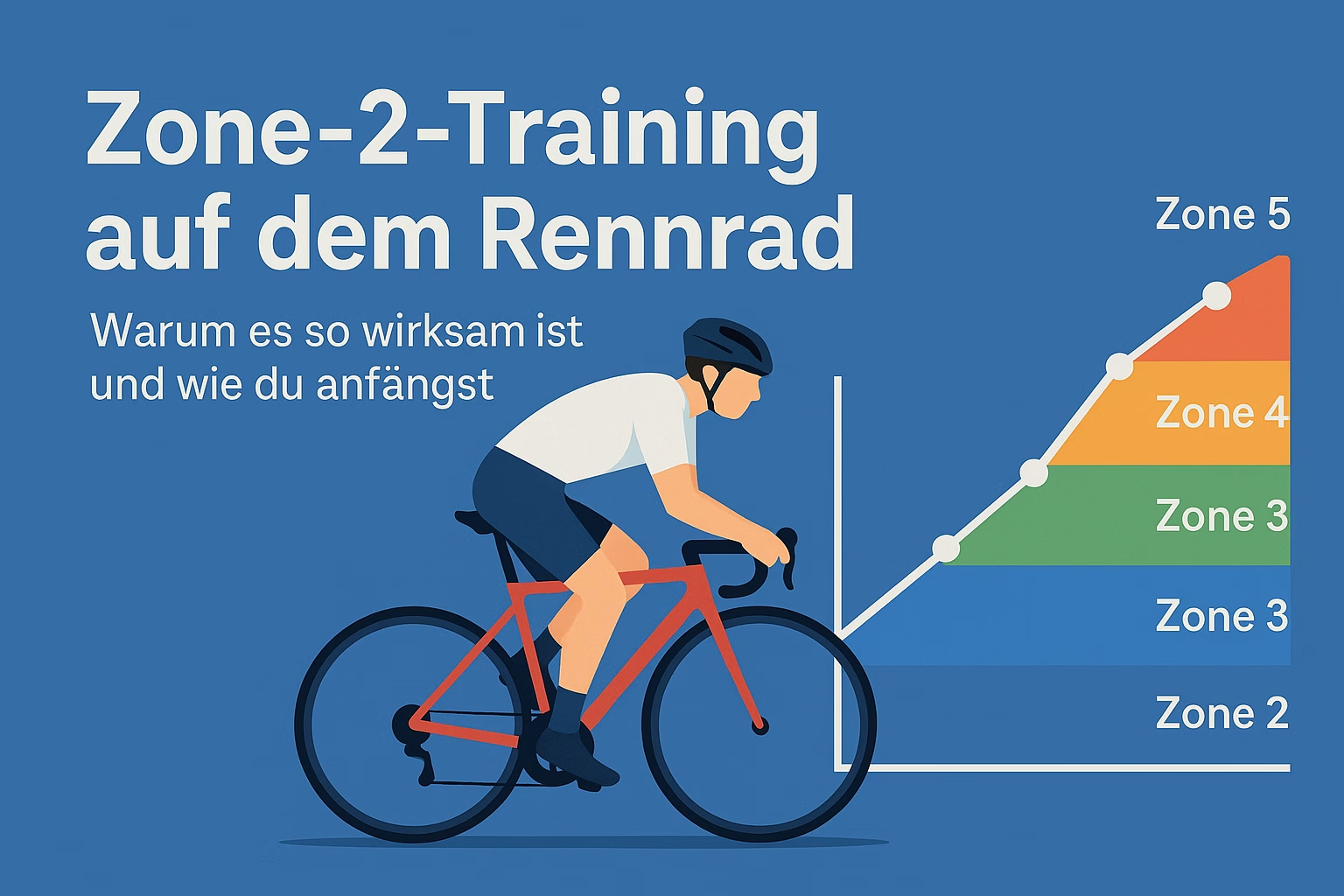
Road cycling · training theory
Zone 2 training on a road bike: why everyone is talking about it and how to get started
Zone 2 may sound like riding slowly with no purpose, but it is one of the strongest ways to build your aerobic endurance. Here, you will learn what it involves, how to find your zone 2 and how to start your first few weeks with a clear plan.
Zone 2 road cycling training has gone from an insider tip to a regular feature of many training plans in recent years. Coaches, professionals and ambitious recreational riders talk about base endurance, aerobic capacity and long, controlled, easy sessions. There is sound physiology behind it, rather than just hype. If you want to ride faster and build endurance over the long term without finishing every session exhausted, deliberately planned Zone 2 training is hard to avoid.
What Zone 2 Training on a Road Bike Actually Means
Zone 2 is an intensity range in which your body works predominantly aerobically, with sufficient oxygen. You ride comfortably, can hold a conversation and breathe a little more deeply without panting. Typically, this corresponds to around 60 to 75 percent of your maximum heart rate or roughly 60 to 70 percent of FTP when training with power in watts. Many road cycling beginners initially find this almost too slow, having become used to riding constantly just below the red line on group rides and amid everyday stress.
That is precisely the appeal of Zone 2: the intensity is low enough to sustain for a long time, yet high enough to improve base endurance very specifically without constantly overloading yourself.
| Zone | Heart Rate Guideline | How It Feels on the Bike |
|---|---|---|
| Zone 1 | up to approximately 60 % HRmax | very easy, almost like walking |
| Zone 2 | approximately 60–75 % HRmax | easy, you can speak full sentences comfortably |
| Zone 3 | approximately 75–82 % HRmax | noticeably demanding, conversation limited to short sentences |
| Zone 4 | approximately 82–90 % HRmax | hard, you are clearly working and talking is difficult |
| Zone 5 | over 90 % HRmax | very hard, only short intervals possible and barely able to speak |
As a simple rule of thumb, you are in Zone 2 when you can chat comfortably during the ride without gasping for breath. If you can only manage individual words, you are well above your target zone and closer to intense intervals in Zone 4/5.
Why Zone 2 Training Improves Your Base Endurance So Effectively
The major advantage of Zone 2 training is that your body receives plenty of consistent, repeatable stimulus without being pushed to its maximum in every session. In this range, your cardiovascular system improves, muscle capillary density increases, mitochondria become more capable and fat metabolism becomes more efficient. These are exactly the adaptations needed to ride long distances comfortably, climb steadily and keep pushing the pedals after several hours.
In practical terms, Zone 2 builds a strong foundation. Add fast group rides, sprints or interval blocks and you get the best of both worlds: strong endurance and enough punch for the hard moments.
How to Find Your Personal Zone 2
To target Zone 2 road cycling training effectively, you need a rough idea of where this range lies for you. The simplest method uses maximum heart rate. If you know your approximate HRmax, estimate Zone 2 at around 60 to 75 percent of that figure. Performance testing or an FTP test provides greater precision, but heart rate is a perfectly adequate guide when starting out.
| HRmax | Zone 2 Range (Approximately 60–75 % HRmax) |
|---|---|
| 180 bpm | 108–135 bpm |
| 190 bpm | 114–143 bpm |
| 200 bpm | 120–150 bpm |
Zone 2 is often considerably lower than the intensity many people usually ride at. The key is to combine numbers with perceived effort. If an otherwise appropriate heart rate feels very hard on a particular day, it signals a need to adjust your pace, rather than a lack of strength.
How to Get Started with Zone 2 Training on Your Bike
Getting started with Zone 2 is straightforward. You do not need a high-end power meter: a heart rate strap and some consistency are enough. Plan two or three weekly sessions aiming to stay in your Zone 2 as consistently as possible. Beginners can start with 45–60 minutes, while more advanced riders might aim for 90–150 minutes per session.
| Day | Unit | Zone |
|---|---|---|
| Tuesday | 60–75 minutes of easy riding | predominantly Zone 2 |
| Thursday | 90 easy minutes with a few short accelerations | Zone 2 base, short peaks |
| Sunday | 120 minutes of easy base endurance | steady Zone 2 |
A week like this automatically shifts your training focus towards base endurance. Many riders find that longer rides feel easier and recovery from hard sessions improves after just a few weeks.
Measuring Progress: The Numbers That Show Zone 2 Is Working
If you love statistics, Zone 2 training is ideal. One simple method is to ride the same route repeatedly in Zone 2 and track changes in heart rate and speed. A lower average heart rate alongside a higher pace clearly indicates improved efficiency.
| Period | Average HR | Average Speed |
|---|---|---|
| Week 1 | 145 bpm (Baseline) | 26.5 km/h |
| Week 6 | 141 bpm ▼ −4 bpm | 27.6 km/h ▲ +1.1 km/h |
| Week 10 | 139 bpm ▼ −6 bpm | 28.2 km/h ▲ +1.7 km/h |
Conclusion: Why You Should Start Zone 2 Training Now
Zone 2 road cycling training is no magic trick, but a clear approach to systematically improving base endurance. You ride easily more often, accumulate consistent mileage, ease the load on your nervous system and prepare your body to handle intense efforts better. For beginners, Zone 2 is an ideal introduction to a structured training plan; for experienced riders, it is the building block that determines whether intervals produce results or simply add fatigue.
If you love statistics, you can treat almost every session as a small study, watching changes in heart rate, pace, power and recovery. If you simply want longer, more relaxed and ultimately faster road rides, the next step is clear: schedule regular Zone 2 sessions over the coming weeks, keep your pace consistently in that range and watch your numbers improve slowly but noticeably.
0 Comments