
Strengths and weaknesses
-
Practical beam pattern
Wide enough for the road + verges. -
Easy operation
Clear and good with gloves too. -
Practical & robust
Straightforward in daily use. -
Often bright enough for country roads
Sufficient at twilight or night in many situations.
-
Aero cockpit mounting
Can be fiddly depending on the setup. -
Alignment matters
Otherwise there is a risk of dazzling others. -
Mode increments
Solid, but not always perfectly fine-tuned.
Mounting on the Canyon Aeroad
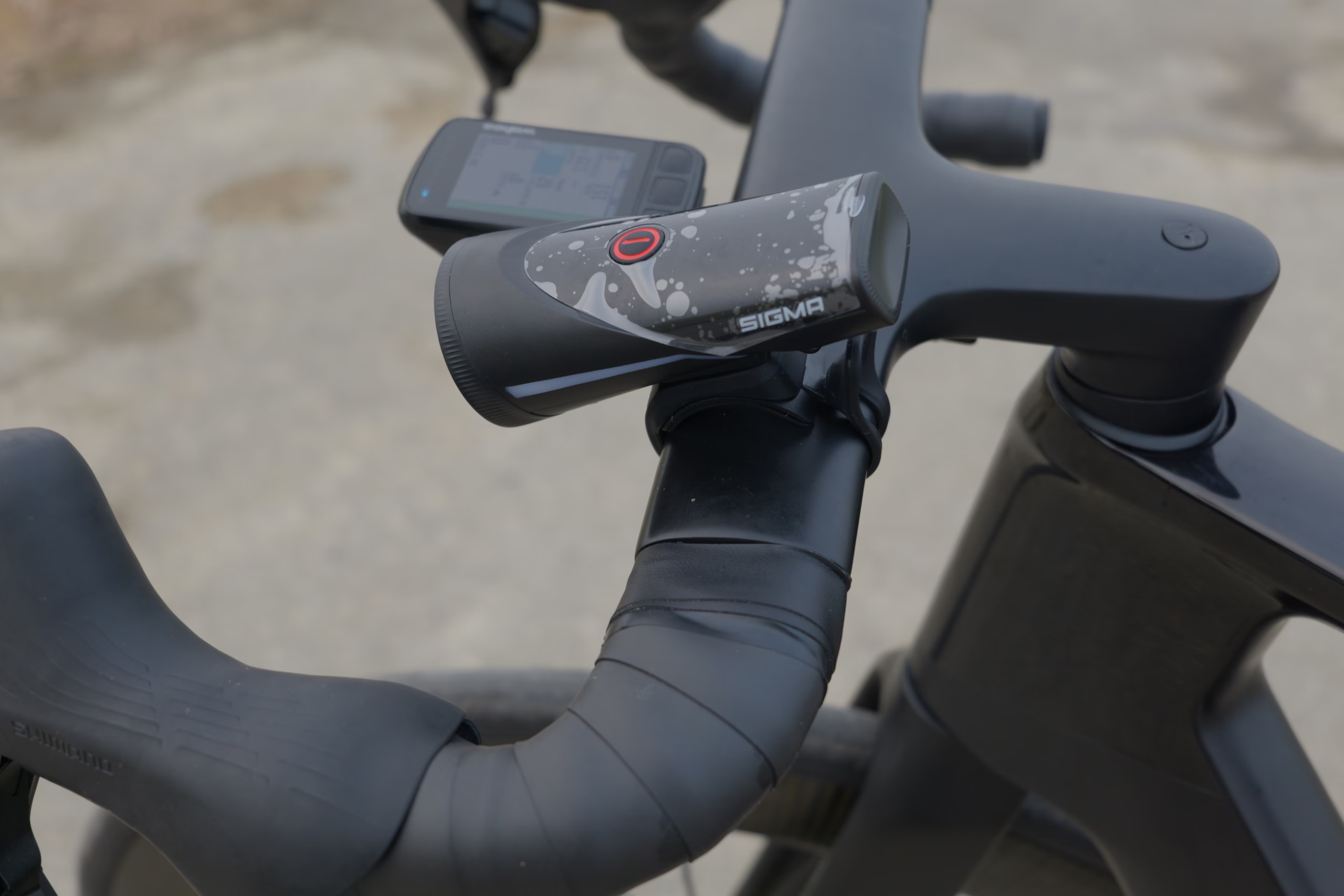
The Aeroad's front area is often already occupied by a computer mount, integrated handlebar and few round sections. The Aura 100 can be mounted, but handling depends heavily on the actual space available and existing mounts. On a crowded cockpit, finding a position and angle without conflicting with the computer mount quickly becomes a game of Tetris. The mount is also designed for round handlebars: its geometry therefore does not match an aero bar's shape 100%, making ideal alignment more demanding. Once correctly positioned, however, the light holds firmly and reliably. Its angle should be adjusted carefully, as pointing a light this powerful too high can quickly become unpleasant for oncoming traffic.
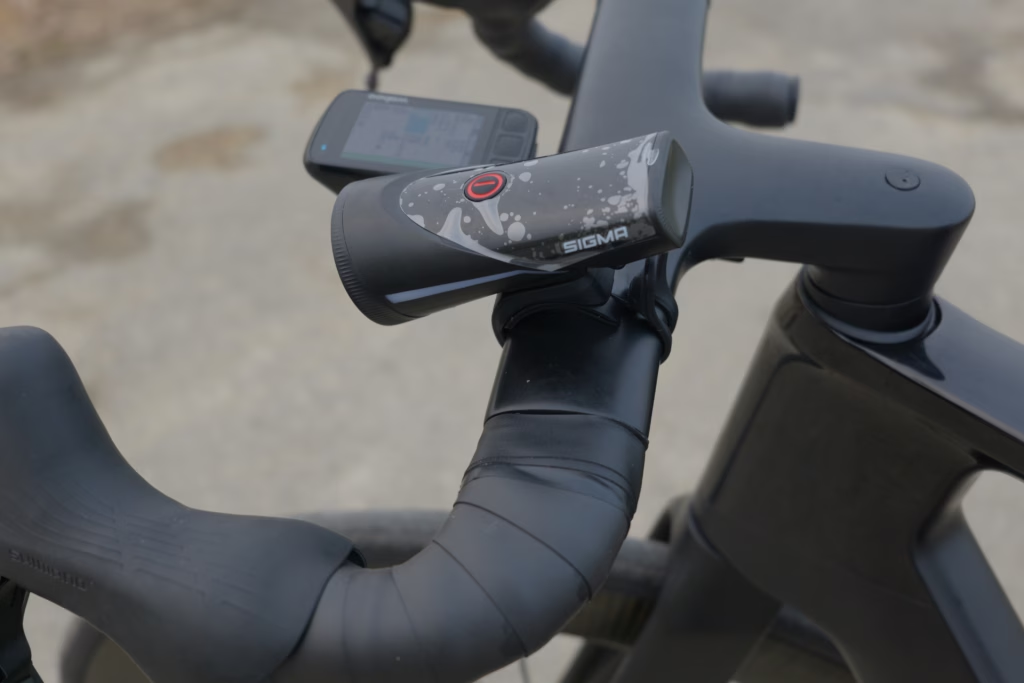
On the Canyon Aeroad, the mount's rubber strap needs noticeably more tension than on many round handlebars. The circumference in the test was around 11.5 cm, requiring considerable force to stretch it. Nevertheless, the mounting ultimately held reliably and worked while riding.
Beam pattern & brightness
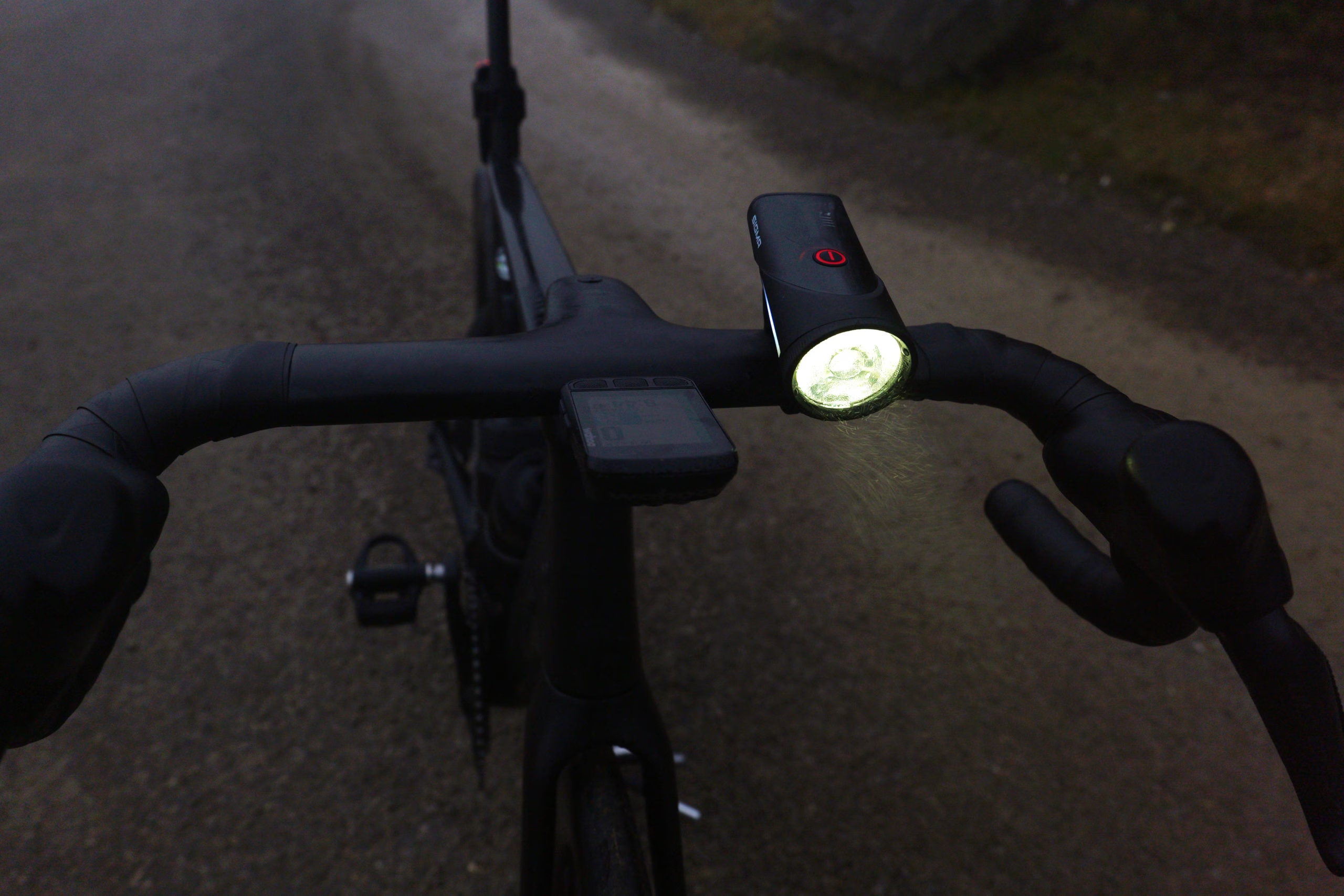
In practice, the numerical figure matters less than whether the beam reveals contrasts: edges, potholes, wet tarmac or dirt at the roadside. This is where the Aura 100 delivers a useful, relatively wide beam that works reliably on typical road cycling surfaces such as tarmac and simple farm tracks without technical trails. On unlit country roads, it illuminates enough area for you to anticipate what lies ahead.
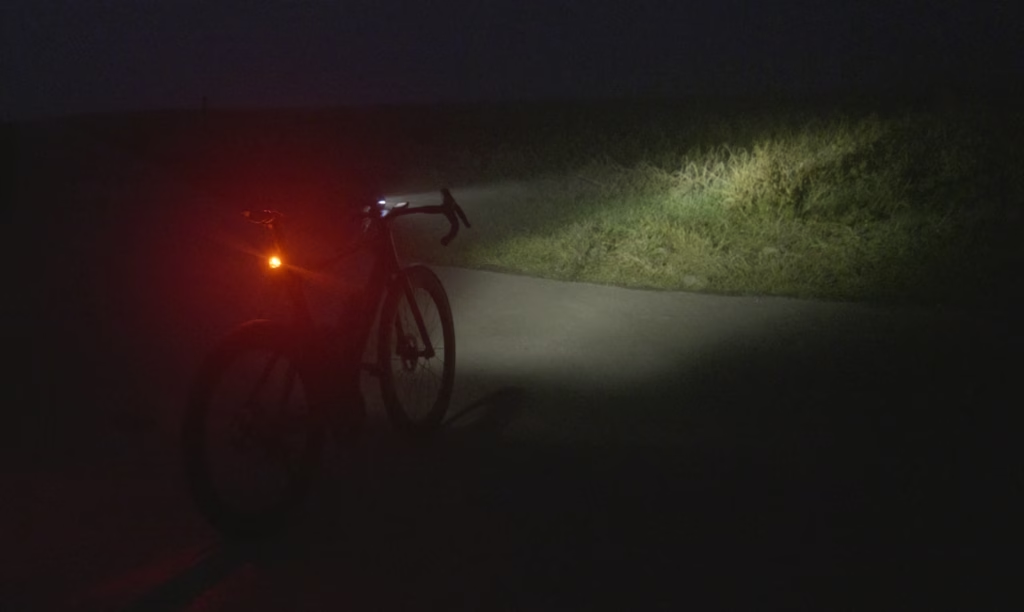
In the city, the highest mode often feels excessive, making a lower setting more sensible. Reflections increase noticeably on wet roads, so careful alignment and the right brightness setting become especially important. Its limitations appear particularly in very dark woodland sections at high speed: the beam is designed more for roads and everyday use than as a true off-road floodlight.
Controls: straightforward, few extras
Controls: straightforward, few extras
The Aura 100 follows a very simple approach: switch on with a double press to prevent accidental activation in a backpack. It starts in AUTO mode, where the integrated brightness sensor adjusts output to ambient light. Short presses cycle through the modes (AUTO → 100 lux → 75 lux → 50 lux → Eco approx. 25 lux). A long press of around 2 seconds switches it off.
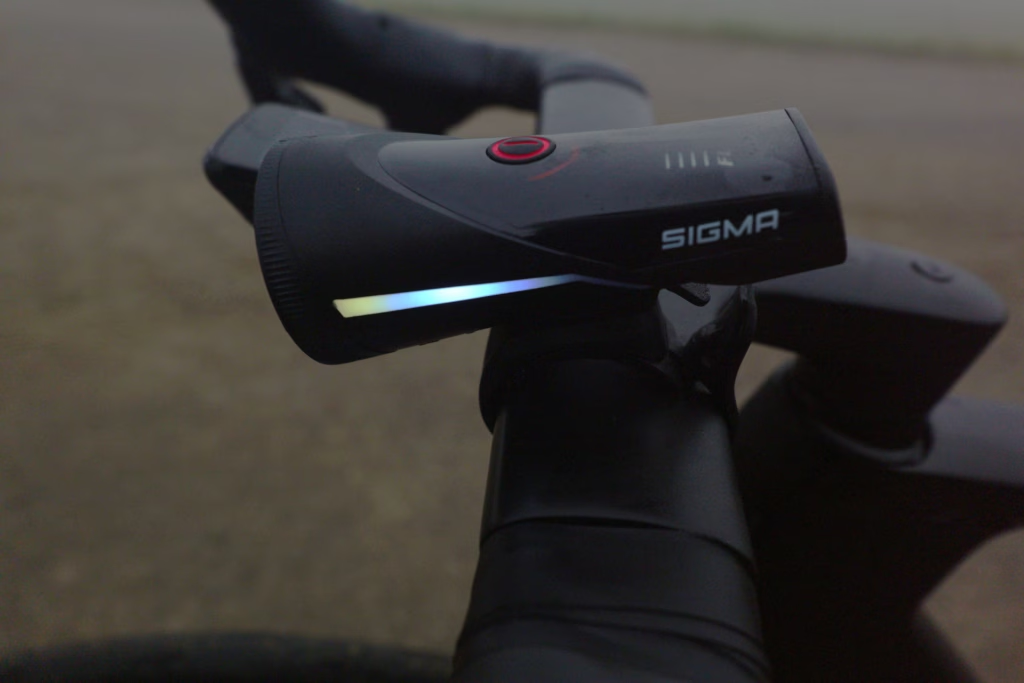
Aura Link allows the front light to pair wirelessly with compatible rear lights. In practice, the rear light can then switch on and off together with the front light directly through the Aura 100 button, and the paired rear light's battery level can be monitored on the front light's indicator. This worked exactly as expected with the Sigma RECO 80 Link in the test: the rear light switches conveniently with the Aura 100, and battery status remains visible. An important distinction is that the RECO 80 radar function is separate: radar warnings generally appear on a compatible bike computer or display, rather than on the Aura 100 front light.
Stability while riding
On the Aeroad, vibrations and impacts can reach the cockpit much more directly than on comfort-focused bikes. Rough tarmac, cobblestones and poor transitions quickly reveal whether an accessory is truly secure. The Aura 100 remained consistently steady in the test: neither the angle gradually shifted nor the position crept upwards or sideways. The very high tension required on the rubber strap around an aero handlebar probably helps by building substantial preload, holding the mount noticeably firmly. Nevertheless, a quick pre-ride check makes sense, particularly with a crowded cockpit, a light mounted far out to the side or after especially rough riding.
Battery life and charging time
The Aura 100 suits everyday commuting and training rides well, provided expectations remain realistic: its highest setting is designed for maximum visibility, not endless runtime. A charging test measured around 4:22 h from 0 to 100%. Firm figures for 0 to ~80% are rare; as a rough guide, the measurements suggest that much of the capacity should be available after around 2.5–3 hours.
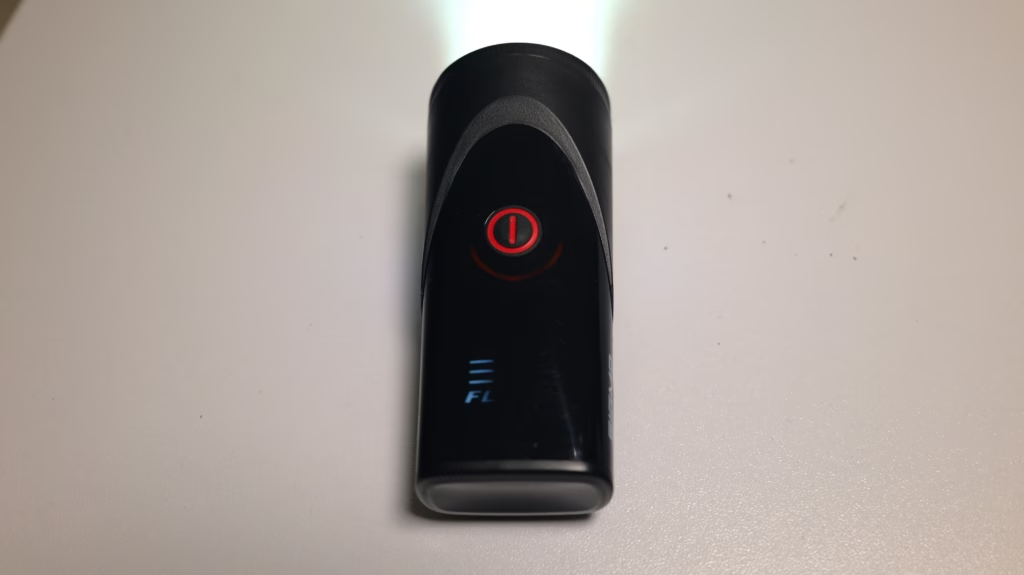
Typical runtime on the brightest setting is around 3 to 3:15 hours, with 195 minutes measured in the test. On the lowest setting, around 12 to 13 hours is realistic; the test measured 769 minutes / ~12:49 h. In practice, for longer rides it is worth using maximum output only where it is really dark and selecting a lower setting elsewhere.
Weight
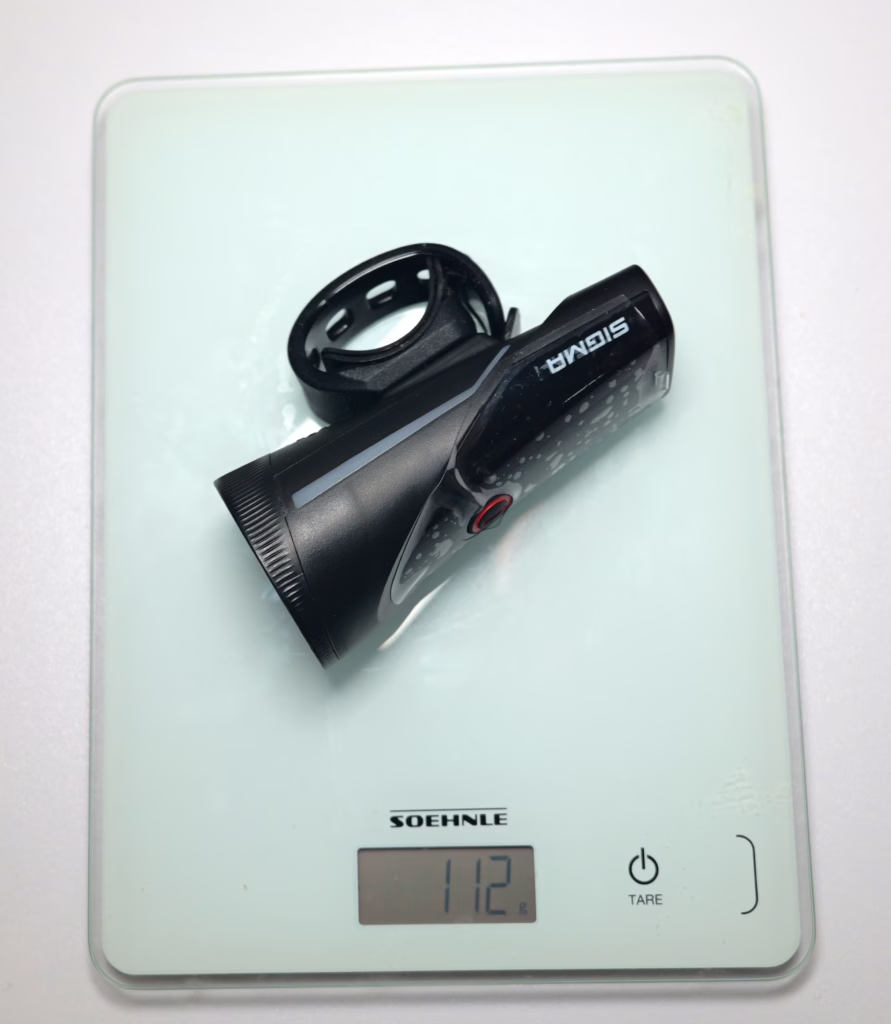
The Sigma Aura 100's weight is typical for a powerful rechargeable front light: we measured 112 g in the test. Although noticeable on the scales for a road bike, this barely matters in practice. Secure mounting and a clean beam pattern are more important.
Who is the Sigma Aura 100 useful for?
The Sigma Aura 100 makes most sense if you regularly ride in the dark during autumn and winter, whether commuting or training in the evening. It particularly shows its strengths on routes with unlit country roads, delivering a practical beam without an app or complicated extras. Anyone seeking a simple, robust solution who values everyday usability and value for money more than an exceptionally clean aero setup will generally be well served.
The Aura 100 is less suitable if the cockpit is extremely crowded and highly integrated, appearance must remain minimal, or very long night rides are planned continuously at maximum output. For off-road or trail riding in complete darkness, its beam is likewise more road- and everyday-focused than that of a dedicated trail light.
Verdict
The Sigma Aura 100 is a solid, bright and easy-to-use front light that can impress on the road and in everyday use. It basically works on the Canyon Aeroad, although mounting is not always elegant and correct alignment is particularly important. Anyone seeking a straightforward light for dark country roads and winter rides gets a useful overall package, with the typical aero cockpit limitations.
0 Comments